
Running a small business in Canada means tracking a lot of moving parts, and taxes sit near the top of that list. Professional tax planning services can help you understand which expenses are deductible, how to structure your claims, and where you can make smarter financial decisions throughout the year.
Every dollar spent to earn business income deserves attention, but not every expense qualifies as a tax deduction. The Canada Revenue Agency (CRA) has specific rules about which costs businesses can claim, how to calculate eligible amounts, and what documentation they must maintain.
Understanding how small business tax deductions in Canada work can affect how much you owe at filing time and how much cash you retain in your business throughout the year. This guide explores the small business tax deductions available in 2027, the expenses you may be able to claim, where the CRA draws the line, and the common mistakes to avoid.
What Counts as a Deductible Business Expense?
The CRA generally allows businesses to deduct reasonable current expenses incurred to earn business income. However, the rules distinguish between operating expenses, capital purchases, and personal costs.
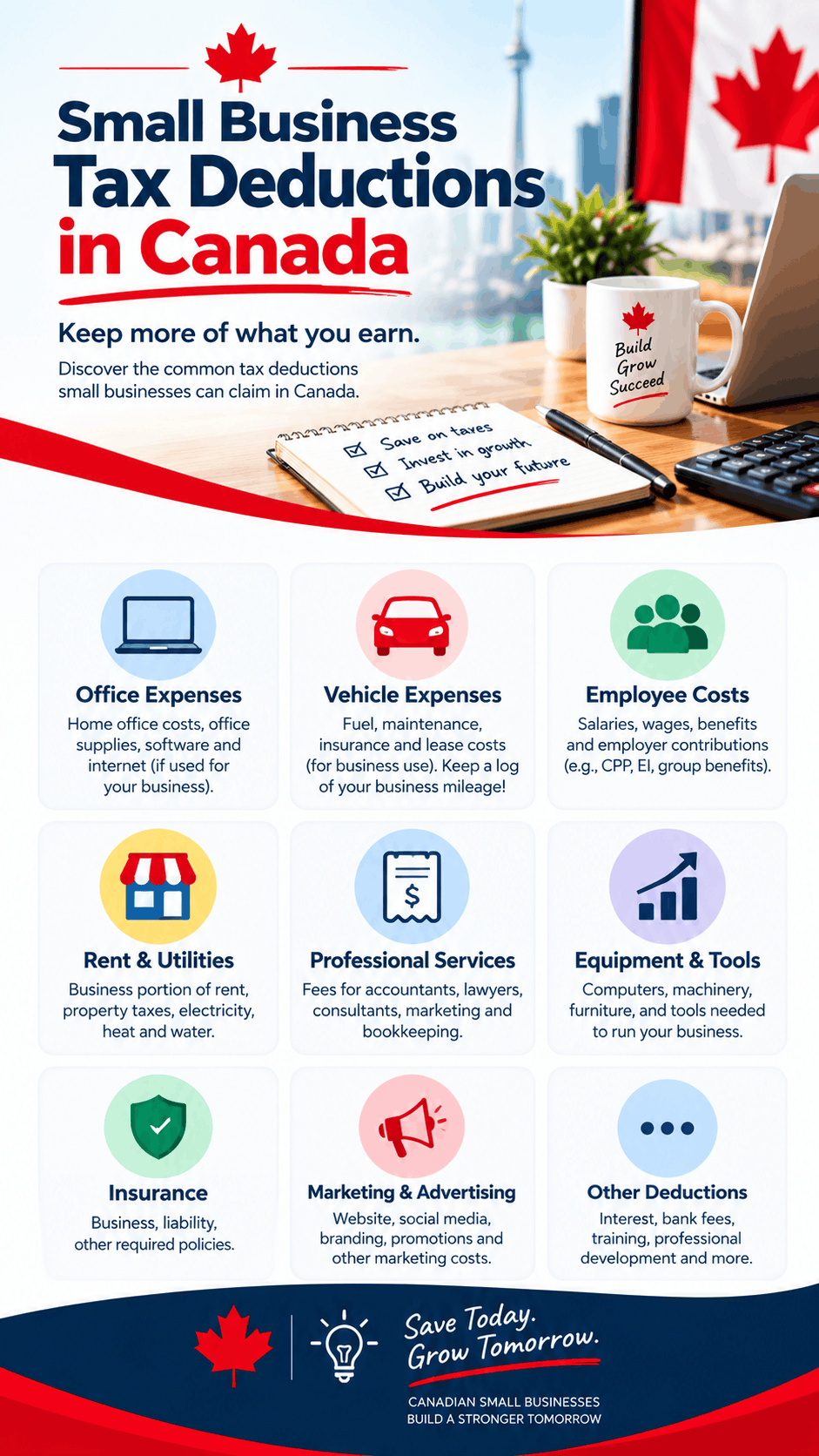
Common business tax deductions in Canada include:
- Office rent and utilities
- Salaries, wages, and employee benefits
- Business insurance
- Advertising and marketing
- Professional fees, including accounting and legal services
- Supplies and inventory costs
- Software and business subscriptions
- Interest and bank charges on business-related borrowing
- Maintenance and repairs
- Business-related travel expenses
Capital purchases, such as equipment and machinery, generally cannot be deducted in full as regular operating expenses. Instead, eligible purchases may qualify for Capital Cost Allowance (CCA), which allows businesses to deduct their cost over time.
The CRA also requires businesses to maintain supporting documentation for their expense claims. Keep receipts, invoices, bank statements, contracts, and other relevant records for at least six years from the end of the last tax year to which they relate. These documents help establish that the expenses were legitimate and connected to earning business income.
Home Office Expenses
If you operate your business from home, you may be able to deduct a portion of your household expenses. However, the CRA has specific eligibility requirements for claiming business-use-of-home expenses. You can generally claim these expenses if your home is your principal place of business. You may also qualify if you use a specific area exclusively to earn business income and regularly meet clients, customers, or patients there.
Eligible expenses can include:
- Rent, if you rent your home
- Heating and electricity
- Home insurance
- Cleaning and maintenance costs
- Property taxes
- Mortgage interest, if you own your home
- Capital Cost Allowance (CCA), where applicable
The deductible portion depends on how much of your home you use for business. A reasonable calculation typically involves dividing the workspace’s square footage by the total area of your home. If you use a room for both business and personal activities, you must also account for the amount of time spent using it for business. For example, if a room serves as both your office and a personal living space, the business-use percentage should reflect the time allocated to work.
You should also consider how frequently you use the workspace throughout the year. If you operate your business from home for only part of the year, your claim may need to be adjusted accordingly. One important restriction is that business-use-of-home expenses cannot create or increase a business loss. If you cannot deduct the full eligible amount in the current year because your business income is insufficient, you may be able to carry the unused expenses forward to a future year, provided you continue to meet the eligibility requirements.
Keep your calculations and supporting records to explain how you determined the business portion of your household expenses.
Vehicle Expenses
Vehicle costs are among the most commonly misunderstood small business tax deductions in Canada. The amount you can claim depends on how much you use your vehicle for business rather than personal purposes. If you’re self-employed and use your vehicle for both business and personal activities, you can generally deduct the business-use portion of eligible actual expenses.
- These expenses may include:
- Fuel and oil
- Vehicle insurance
- Registration and licensing fees
- Maintenance and repairs
- Electricity costs for eligible electric vehicles
- Interest on vehicle financing, subject to applicable limits
- Leasing costs, subject to applicable limits
To calculate your deduction, divide the kilometers driven for business by the total kilometers driven during the year. Multiply the resulting percentage by your eligible vehicle expenses. For example, if you drive 20,000 kilometers in a year and 8,000 are for business purposes, your business-use percentage is 40%. You can generally claim 40% of your eligible vehicle operating costs, subject to the applicable CRA rules.
A mileage log is essential for supporting this calculation. Record the date, destination, purpose, and distance of each business trip. You should also maintain odometer readings at the beginning and end of your fiscal period. It’s important to distinguish these deductions from the CRA’s prescribed per-kilometer allowance rates. Those rates generally apply when employers reimburse employees for using their personal vehicles for business. They are not a flat-rate deduction that self-employed individuals can automatically apply to their own vehicle expenses.
For 2027, check the latest CRA and Department of Finance Canada announcements before using annual automobile deduction limits, including passenger vehicle CCA ceilings, lease deduction limits, and vehicle loan interest caps. Do not rely on previous years’ figures as confirmed 2027 amounts.
Capital Cost Allowance (CCA)
Major business purchases, including equipment, machinery, computers, and vehicles, are generally treated differently from everyday operating expenses. Rather than deducting their entire cost immediately, businesses may claim Capital Cost Allowance (CCA) over time. The CRA groups depreciable assets into different classes, each with its own prescribed CCA rate. The applicable class depends on the type of property and the relevant tax rules.
For example, office furniture and equipment may fall into a different class from computer hardware or passenger vehicles. Understanding these classifications helps businesses calculate the correct deductions.
CCA is particularly important when your business invests in expensive equipment or other long-term assets. However, claiming it is generally optional, so you can consider how much to claim in a particular year based on your financial and tax situation. Vehicle-related CCA also has specific rules and annual limits. These limits can change, so check the applicable CRA guidance before calculating your 2027 claim.
Meals, Entertainment, and Travel
Business meals, entertainment, and travel expenses can qualify as deductions, but the CRA applies specific restrictions. Meals and Entertainment: In most cases, businesses can deduct 50% of eligible food, beverage, and entertainment expenses, based on the lesser of the amount incurred or an amount considered reasonable. These expenses should have a legitimate business purpose, such as meeting a prospective client, discussing a project with a business partner, or entertaining a customer.
Keep the receipts and record the business purpose of each expense, including the people involved.
Business Travel: Travel expenses incurred to earn business income may qualify for deductions. These can include flights, accommodation, public transportation, and other eligible travel costs. However, meals consumed during business travel are generally subject to the same 50% deduction limit. Personal vacations and unrelated travel costs do not qualify simply because you conduct some business activities during the trip.
Salaries, Contractor Payments, and Benefits
Businesses can generally deduct reasonable salaries and wages paid to employees for their work. Employer contributions to the Canada Pension Plan (CPP), Employment Insurance (EI), and eligible employee benefit plans may also qualify. Payments to contractors and freelancers can be deductible when they relate to legitimate business services.
However, the CRA looks at the actual working relationship when determining whether someone is an employee or an independent contractor. Factors such as control over the work, ownership of equipment, financial risk, and the opportunity for profit can influence this assessment. Misclassifying employees as contractors can result in unpaid payroll deductions, interest, and penalties. Business owners should ensure their arrangements accurately reflect the nature of the working relationship.
Marketing, Software, and Professional Services
Promoting your business and managing its daily operations involve expenses that may qualify as tax deductions. Many of these costs are directly connected to earning business income.
Examples include:
- Website hosting, maintenance, and eligible design expenses
- Paid advertising through search engines, social media, and print publications
- Branding and graphic design services
- Business software subscriptions, including accounting tools and CRM platforms
- Bookkeeping and accounting fees
- Legal services related to business operations
- Project management and communication tools
These expenses are generally deductible when they are reasonable and incurred to earn business income. However, some larger purchases or costs that create lasting assets may be treated as capital expenses rather than regular operating expenses.
Keep business and personal subscriptions separate wherever possible. If a service is used for both purposes, only the eligible business portion should be claimed.
What’s Not Deductible?
Not every expense associated with running a business qualifies for a tax deduction. Some costs may appear business-related but fall outside the CRA’s rules.
Common non-deductible expenses include:
- Personal and household expenses unrelated to business activities
- The personal-use portion of mixed-use vehicles, phones, and home offices
- Fines and penalties
- Recreational club membership fees
- Most life insurance premiums
- Political contributions
- Expenses related to earning tax-exempt income
The distinction between personal and business spending is particularly important for small business owners who use the same accounts or payment methods for both. Maintaining separate business accounts, keeping detailed records, and reviewing expenses regularly can help prevent incorrect claims and potential reassessments.
Work With Pitre James Business & Tax
Pitre James Business & Tax works with small business owners across Kelowna to identify eligible deductions, maintain accurate financial records, and approach tax filing with greater confidence.
From home office and vehicle expenses to Capital Cost Allowance and broader corporate tax planning, the team helps business owners understand the rules that apply to their circumstances rather than relying on a generic checklist.
If 2027 is the year you want to take a closer look at which business expenses are tax deductible in Canada, Pitre James Business & Tax provides reliable tax planning services to help you make informed decisions and plan ahead.
