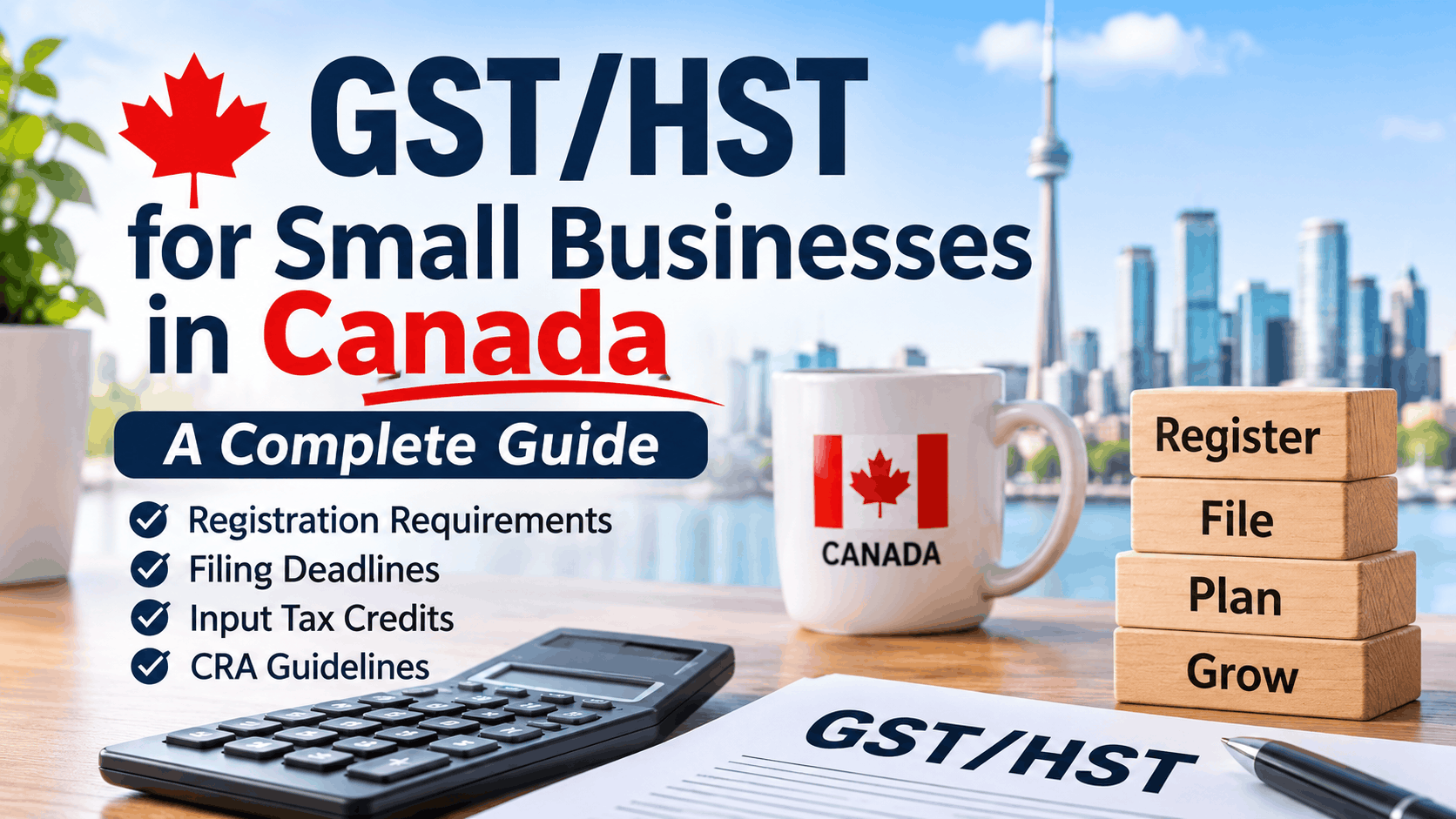
Running a small business in Canada involves several financial responsibilities, and understanding sales taxes is one of them. Whether you operate a retail store, provide professional services, or run an online business, you may need to collect and remit the Goods and Services Tax (GST) or Harmonized Sales Tax (HST) on your sales.
Working with professional accounting services can also help small business owners manage these tax obligations and keep their financial records in order. However, not every business has to register immediately. The Canada Revenue Agency (CRA) has specific registration requirements based on business revenue, taxable supplies, and other factors.
This guide explains the GST/HST rules for small businesses in Canada, including registration, filing, input tax credits, and provincial considerations for businesses operating in British Columbia.
GST/HST Registration Requirements for Small Businesses in Canada
Most businesses that make taxable supplies in Canada must register for a GST/HST account once they stop qualifying as small suppliers. However, businesses that remain below the registration threshold generally have the option to register voluntarily.
The CRA considers a business a small supplier when its total revenue from worldwide taxable supplies, including those of associated businesses, does not exceed $30,000 over four consecutive calendar quarters or in a single calendar quarter. When calculating this amount, businesses must include zero-rated supplies but exclude exempt supplies, financial services, and sales of capital property. The calculation also excludes goodwill from the sale of a business.
There are two important situations to understand:
Exceeding $30,000 in one calendar quarter: The business stops qualifying as a small supplier immediately. It must charge GST/HST on the sale that takes it over the threshold and register within 29 days of its effective registration date.
Exceeding $30,000 over four consecutive quarters: If the business does not exceed the threshold in any single quarter but crosses it over four consecutive quarters, it stops qualifying as a small supplier at the end of the month following the quarter in which it exceeded the limit. Understanding these registration requirements is also part of effective Corporate Tax Planning Strategies, particularly for businesses looking to manage their tax obligations as they grow.

How to Register for a GST/HST Account in Canada
Once a business meets the mandatory registration requirements, its owner must register with the CRA. Businesses that qualify as small suppliers can also register voluntarily if they make taxable supplies in Canada. Business Registration Online (BRO) is the CRA’s online registration service. As of July 14, 2026, business owners must access it through their CRA account.
Here are the steps involved:
Step 1: Gather Your Business Information
Prepare the information required for registration, including your business name, business structure, Business Number (BN), business address, owners’ details, and a description of your primary business activities. If you do not already have a Business Number, the CRA can issue one during registration.
Step 2: Sign In to Your CRA Account
Access your CRA account and navigate to Business Registration Online. Select the option to register a business and follow the instructions.
Step 3: Choose Your GST/HST Account
Provide the requested information about your business and select the GST/HST program account. You will also need to identify your effective registration date and provide details about your business revenue.
Step 4: Review and Submit Your Application
Check that all the information is accurate before submitting your registration. Once the process is complete, save your Business Number and GST/HST account details for future reference.
Step 5: Update Your Invoicing and Accounting Records
After registration, update your invoices and accounting system to reflect the applicable tax rate. Keep track of the GST/HST collected from customers and the tax paid on eligible business purchases. Remember that your GST/HST account comes with ongoing responsibilities. You must collect applicable taxes, file returns, and remit the amount owed to the CRA.
How to File GST/HST Returns for a Small Business
Filing GST/HST returns allows businesses to report the tax collected from customers and claim eligible input tax credits. The difference between these amounts determines how much tax the business must remit or whether it is entitled to a refund. Small businesses can file their returns through the CRA’s online services or other approved electronic filing methods.
Follow these steps:
Step 1: Organize Your Financial Records
Collect sales invoices, purchase receipts, expense records, and other documents showing the GST/HST collected and paid during the reporting period.
Step 2: Calculate the GST/HST Collected
Add the GST/HST charged on taxable sales during the reporting period. Make sure the figures match your sales records and accounting software.
Step 3: Calculate Eligible Input Tax Credits
Identify the GST/HST paid or payable on eligible business purchases and expenses. Keep the supporting invoices and receipts for your claims.
Step 4: Calculate Your Net Tax
Subtract your eligible input tax credits from the GST/HST collected. This gives you the net tax amount to report.
Step 5: Submit Your GST/HST Return
Sign in to your CRA account, select your business GST/HST account, and choose the option to file a return. Enter the required figures, review the information, and submit the return using GST/HST NETFILE.
Step 6: Pay Any Outstanding Balance
If your return shows that you owe tax, arrange payment by the applicable deadline. Keep your submission confirmation and payment records for future reference. Most GST/HST registrants must file electronically, even when they have no business activity or tax to remit. A nil return is still required for an inactive reporting period.
Maintaining accurate records throughout the year also makes Financial Reporting for Canadian Businesses: What You Need to Know an important consideration for small business owners.
GST/HST Filing Deadlines for Canadian Businesses
GST/HST filing deadlines depend on the reporting period assigned to a business. The CRA generally determines the reporting frequency based on annual taxable sales, although eligible businesses may choose to file more frequently.
The three common reporting periods are:
- Monthly: Businesses with annual taxable supplies exceeding $6 million generally file monthly.
- Quarterly: Businesses with annual taxable supplies exceeding $1.5 million and up to $6 million generally file quarterly.
- Annually: Businesses with annual taxable supplies of $1.5 million or less generally file annually, although they can elect to file more frequently.
For monthly and quarterly filers, both the return and payment are generally due one month after the reporting period ends.
Annual filers usually have three months after their fiscal year-end to file and pay. However, sole proprietors with a December 31 fiscal year-end who earned business income have a different schedule: payment is due by April 30, while the filing deadline is June 15.
How to Claim Input Tax Credits in Canada
Input tax credits (ITCs) allow registered businesses to recover the GST/HST paid or payable on eligible purchases and expenses used in their commercial activities. For example, a registered business that purchases office equipment for $2,000 and pays $100 in GST may be eligible to recover that $100 through an input tax credit, provided the purchase meets the CRA’s requirements.
Common expenses that may qualify for ITCs include:
- Office supplies and equipment
- Business rent and utilities
- Telephone and internet services
- Fuel and eligible vehicle expenses
- Legal, accounting, and professional fees
- Delivery and freight charges
- Business-related travel
- Maintenance and repair expenses
- Eligible business start-up costs
However, not every purchase qualifies. Personal expenses, certain club memberships, and purchases used to make exempt supplies generally do not qualify for ITCs.
To claim an input tax credit, follow these steps:
- Check your eligibility: Confirm that the purchase relates to your commercial activities and that you were a GST/HST registrant during the relevant reporting period.
- Collect supporting documents: Keep invoices, receipts, and other records showing the GST/HST paid or payable.
- Calculate the eligible amount: Determine how much tax relates to your business use. For expenses with both personal and business use, only the eligible business portion can generally be claimed.
- Include the credit in your return: Report eligible ITCs on the appropriate line of your GST/HST return.
- Maintain accurate records: Keep supporting documentation in case the CRA requests verification.
Claiming eligible ITCs can reduce the net tax a business owes and help manage operating costs. For more on what you can claim, see our guide to small business tax deductions in Canada.

When Does a Small Business Need a GST Number?
A small business needs a GST/HST account when it is no longer considered a small supplier and makes taxable supplies in Canada. The general registration threshold is $30,000 in worldwide taxable supplies over a single calendar quarter or four consecutive calendar quarters.
Businesses that cross the threshold in a single quarter must begin charging GST/HST on the transaction that takes them over the limit. When the threshold is exceeded across four consecutive quarters instead, the effective registration timing follows a different rule.
Certain businesses must register regardless of their revenue. For example, taxi operators and commercial ride-sharing drivers must register for GST/HST even if they qualify as small suppliers. Small businesses that only provide exempt supplies generally cannot register under the regular GST/HST rules. Understanding these requirements helps business owners avoid collecting tax too late or registering unnecessarily.
GST Rules for Small Businesses in British Columbia
Small businesses in British Columbia follow the same federal GST registration threshold and general GST rules as businesses in other Canadian provinces. However, BC does not use HST. Instead, businesses generally charge the federal GST at 5% on taxable supplies made in the province. The province also has a separate Provincial Sales Tax (PST), which generally applies at 7% to taxable goods and certain services.
For example, a registered business selling a taxable product for $100 in BC may charge:
- Product price: $100
- GST (5%): $5
- PST (7%): $7
- Total: $112
The two taxes have separate registration, collection, and reporting requirements. A business registered for GST does not automatically become registered for PST.
BC also has specific PST exemptions and small-seller rules. Eligible small sellers may not need to register for PST, provided they meet the province’s requirements, including the applicable $10,000 revenue limit and restrictions on business premises and sales activities.
Business owners should also remember that GST/HST place-of-supply rules determine which tax rate applies to sales made to customers in other provinces. A BC business shipping taxable goods to a customer in Ontario, for example, may need to charge Ontario’s 13% HST rather than BC’s 5% GST.
Checking the applicable provincial rules is important for businesses selling outside BC.
GST/HST Accounting Services in Kelowna
Managing GST/HST obligations can become complicated as a small business grows. Between tracking taxable sales, maintaining expense records, calculating input tax credits, and meeting filing deadlines, business owners have several responsibilities to manage.
Professional accounting support can help simplify these tasks. Businesses looking for GST/HST accounting services in Kelowna can work with an experienced accountant or bookkeeper to manage their sales tax records and reporting requirements.
Depending on their needs, these services may include:
- GST/HST registration and account setup
- Preparation and filing of GST/HST returns
- Input tax credit calculations and documentation
- Sales tax reconciliation
- Bookkeeping and financial record management
- Assistance with CRA notices and compliance requirements
Conclusion
Understanding GST/HST requirements is an important part of running a small business in Canada. From knowing when registration becomes mandatory to filing returns and claiming input tax credits, each responsibility plays a role in keeping business finances organized and tax records accurate.
If managing sales tax obligations becomes time-consuming, professional accounting support from Pitre James Business & Tax can help simplify the process and keep your business on track.
